The Radar Screen competitor map is one of my favorite competitive intelligence tools. It is totally visual and fits on one page for easy digestion. It can be used both strategically and tactically and is a rich communication tool. I first read about it in Adrian Slywotzky’s Value Migration: How to Think Several Moves Ahead of the Competition in the 1990’s. I blogged about the Radar Screen in 2009, using a retail example that I have updated here.
Radar Screen: Visualize the Competition
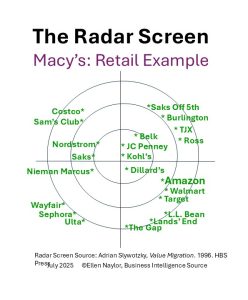
The Radar Screen is a great way to visualize how competitors are positioned relative to your company and to each other. The retail Radar Screen shows competitors relative to Macy’s, the large retail department store which offers a broad spectrum of products including clothing, housewares, bed & bath, jewelry, shoes, cosmetics, fine china, handbags, and various accessories.
Macy’s is experiencing harder times presently and has a big plan to close 150 stores in 2025-26. The store closures have given off-price retailers like TJX (Maxx, Marshalls), Ross and Burlington more opportunities to capitalize on consumer’s shift to value pricing. However, I place them further out on the radar screen since they do not offer Macy’s full range of products, mostly competing in clothing and shoes.
Assessing the Competitive Landscape
JC Penney and Kohl’s are Macy’s most direct competitors in the budget to mid-range department store market, and offer a broad spectrum of similar products in their stores and on-line. Dillard’s and Belk compete similarly in some regions across the US. Nordstrom, Saks and Nieman Marcus compete for the high-end business, so are placed further out on the Radar Screen. (Macy’s owns Bloomingdale’s which competes directly with Nordstrom and the others.)
Amazon, Walmart and Target compete in some areas with Macy’s, although Walmart competes mostly on price, while Target is a bit more upscale than Walmart. Walmart and Target fit in the next tier as they both sell clothing, bed and bath and housewares, but also sell food and sporting goods where they don’t compete with Macy’s. Amazon competes across many of Macy’s product lines, adding more all the time. Probably the biggest challenge to Macy’s from Amazon is that they’ve become a one-stop shop for many consumers.
Costco and Sam’s Club compete across some of Macy’s product lines such as clothing, bed & bath, housewares and furniture, so they’re further out on the Radar Screen. They just offer a narrow selection across their product lines and sell on volume. Both sell food where Macy’s scarcely competes and offer other products that Macy’s doesn’t such as computers and automotive.
The Gap, L.L. Bean and Lands’ End mostly compete in clothing, although not formal clothing, so they’re pretty far out on the Radar Screen.
Lastly, Wayfair, Sephora and Ulta compete in a very limited way. Both Sephora and Ulta compete in beauty products, while Wayfair sells only furniture. This is just a slice of Macy’s business.
Collaborate on the Ever Changing Radar Screen
Ideally you would have a cross-functional team create a Radar Screen competitor snapshot. There is rich discussion about where and why competitors should be placed which is valuable to capture. You might use the Radar Screen as the home page for your company’s competitive intelligence site. They would re-position the competitors based on the news, and visually depict changes with a different color, for example. As you click on each competitor, there would be the relevant news, insight and a competitor profile explaining its positioning. Today, you’d use AI to keep things updated, and in the future perhaps to help with repositioning the competitors on the Radar Screen!
Radar Screen: Be Rewarded for Your Creativity
Be creative: the uses for the Radar Screen competitor map are as rich as your imagination. The screen can be divided into 4 quadrants which might depict competitors by 4 separate business units, 4 different geographies, or on a tactical level 4 different reasons why customers buy.
I have used the Radar Screen with companies who claim they have 20 major competitors in one business unit. This exercise achieves more focus, and we will often narrow that list to 6 – 8 competitors after a rigorous discussion.
Learn more about competitive intelligence
Win/Loss Analysis book; Amazon link to Win/Loss Analysis book
Amazon link to Loosen Their Lips: How to Capture What You Seek During a Conversation book on elicitation
Join our mailing list and get our cheat sheets on “How to Build a World Class Win/Loss Program.”
